Beyond the Sign: Reinforcing Safety Through Visual Communication
Most facilities already have safety signage in place.
The challenge is not whether the message exists.
It’s whether people continue seeing it.
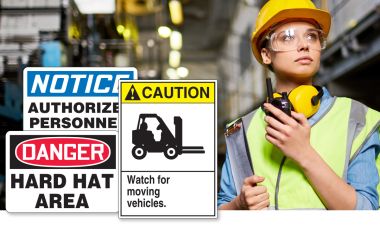
Over time, even important warnings can fade into the background of a busy environment. That’s why effective safety communication is about more than posting signs on walls. It’s about building visual systems that consistently reinforce safe behavior throughout the workday.
Signs remain foundational, but the strongest safety environments support those messages with additional visual cues that guide movement, clarify expectations, and reduce confusion in real time.
Safety Signage Is the Starting Point
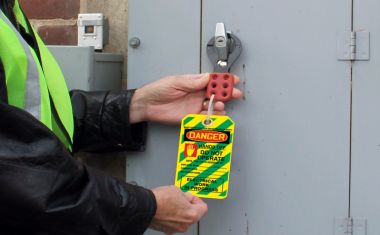
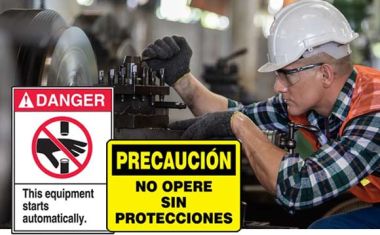
Safety signs play a critical role in communicating hazards, procedures, and required actions.
But static messaging has limitations.
Repeated exposure naturally leads people to filter information out over time. This is especially true in fast-moving facilities where workers are processing large amounts of visual information every day.
That’s why many organizations are shifting from simply adding more signage to building more intentional visual communication systems.
The goal is not just awareness.
It’s reinforcement.
Reinforce Safety Where Decisions Happen
One of the most effective ways to influence workplace behavior is through environmental guidance.
Floor markings, visual pathways, and clearly defined zones help workers navigate spaces without needing to stop and interpret instructions constantly.
These tools can help:
- Separate pedestrian and forklift traffic
- Define restricted or hazardous areas
- Reinforce staging and storage zones
- Improve workflow clarity
When visual standards remain consistent throughout a facility, safe movement becomes easier and more intuitive.
Keep Messaging Visible and Relevant
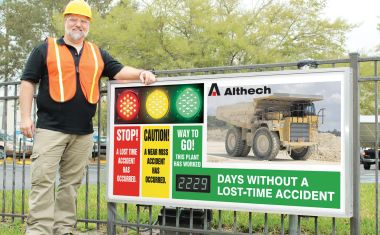
Large-format visuals like banners, scoreboards, posters, and projected messaging help reinforce expectations beyond immediate hazards.
These tools are especially effective for:
- Supporting PPE compliance
- Reinforcing safety initiatives
- Highlighting changing conditions
- Maintaining awareness in high-traffic areas
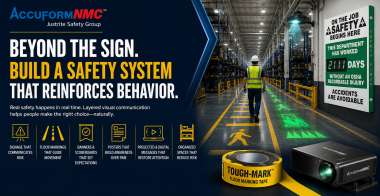
Solutions like projected safety messaging can help improve visibility in active environments where traditional floor communication may wear down or become obstructed. In high-traffic areas, projected walkways and warnings help keep critical messaging visible and attention-grabbing.
Durable identification systems also play an important role. Tough-Mark™ floor markings and visual communication solutions are designed for environments where movement, traffic, moisture, and daily wear are constant factors.
The key is keeping communication active.
Messaging that never changes eventually blends into the environment. Rotating visuals, digital messaging, projected warnings, and durable visual identification systems help restore attention and keep safety communication relevant.
Workplace Organization Supports Visual Safety
Visual communication works best in organized environments.
Cluttered layouts, undefined storage areas, and inconsistent workflows create visual noise that makes hazards harder to recognize.
Clean workspaces, defined zones, and strong visual management practices help safety messaging stand out more clearly.
When environments are organized, workers spend less time interpreting and more time responding appropriately.
Building a More Reinforced Safety Culture
Effective safety communication should not rely on a single moment where someone stops to read a sign.
It should reinforce expectations before, during, and after the task.
Signs, floor markings, banners, labels, posters, projected messaging, and workplace organization all play a role in creating safer environments.
When these systems work together, safety becomes more visible, more consistent, and easier to follow.
Because strong safety cultures are not built by a single message.
They are reinforced by the environment around them.
____________________________________________________________________________
Looking for a deeper dive into visual safety reinforcement strategies?
This article explores additional perspectives on building safer, more behavior-driven workplaces:
Beyond the Sign. Visual Safety That Reinforces Behavior. • Safety Products Inc